DCJ Letter to FRLD Board in Support of Request by Government of Nepal to FRLD
Dear Co-Chairs of the Board, Board Members of the Fund for Responding to Loss and Damage (FRLD),
Rapidly responding to the catastrophic glacier collapse and ensuing flash floods in Nepal, one of the most devastating climate-induced disasters since the Fund’s inception, is a defining moment for the Fund to act without further delay. In keeping with the purpose of the Fund, this warrants formal Board consideration through an Extraordinary Meeting, given the extraordinary circumstances of an unimaginable extreme weather event, in accordance with Paragraph 21 of the Additional Rules of Procedure. Any Extraordinary Meetings called should also happen with meaningful participation of affected communities and civil society, before any formal decision is adopted. The Nepal experience demands the earliest development of rapid disbursement modalities, in accordance with the Fund’s Governing Instrument, as part of the current Barbados Implementation Modalities (BIM) as well as for the long-term model of the Fund.
We therefore welcome the letter submitted by Board Members representing Least Developed Countries, African States, and Asia-Pacific States urgently calling for an Extraordinary Meeting to consider a provisional set-aside allocation of resources to support rapid response funding for Nepal (which we expect the Board’s agreement on), and also to consider procedural lessons for the Fund’s rapid response modalities as part of the BIM as well as for the long-term model. We further note that Australian civil society organizations, including Plan International Australia, Oxfam Australia, and ActionAid Australia, have submitted a similar appeal in light of Australia’s role as President of Negotiations for COP 31, alongside an Asian Peoples’ Movement on Debt and Development-led global sign-on letter endorsed by more than 100 organizations and movements, with additional endorsements continuing to grow.
As we have been keenly awaiting the convening of the Extraordinary Meeting, we now hear that an informal Board meeting is instead scheduled for Wednesday, 16 September 2026. Informal consultations are not equivalent to, and cannot substitute for, formal Board consideration of a decision of this significance. Furthermore, civil society participation is being denied, which questions the transparency and accountability of the Fund.
First, we are deeply disappointed about the informal nature of the upcoming meeting on Wednesday, 16 September 2026, since any outcome out of it would not carry any formal status – resulting in further delay of a necessary response to Nepal. Given the meeting is going ahead anyway, we call on the Board to invite civil society participation in the meeting to ensure transparency and accountability in the process.
Second, we call on the Co-Chairs of the Board and Board Members to convene an Extraordinary Meeting at the earliest, to ensure a proper formal consideration of the response to Nepal. This Extraordinary Meeting must result in a formal outcome of agreement on the provisional set-aside allocation of resources, to provide predictability of support to Nepal. Needless to say, meaningful participation of affected communities and civil society also needs to be guaranteed at this Extraordinary Meeting.
If the Board wishes to meet on this matter, it should do so formally and in accordance with its own governing procedures. Paragraph 21 of the Additional Rules of Procedure clearly states: “In the case of an extraordinary meeting, the Co-Chairs, acting jointly, shall determine the date by which notification to the Board members and Alternate members has to be made, taking into account the urgency of the matter, and the format of the meeting. Such meetings may be held in person, virtually, or with virtual participation in hybrid format.”
Nepal’s situation is precisely the kind of circumstance for which extraordinary procedures exist. Proceeding through informal consultations rather than formal Board deliberation raises serious procedural concerns and risks circumventing the Board’s oversight responsibilities and established decision-making processes.
Transparency and accountability are foundational to the legitimacy of this Fund. We – civil society, local communities, and peoples’ movements – fought for decades for the recognition of Loss and Damage and for the establishment of this Fund itself. We are not external spectators in this process. We are the communities living with the escalating impacts of a crisis we did not create.
We therefore recall Board meeting B.9, much of which was conducted in closed session. Excluding Observers now, from deliberations on a matter of such consequence, would be deeply concerning. At a moment when the Fund is being called upon to respond to one of the most significant climate disasters since its establishment, transparency and accountability should be strengthened, not diminished.
Third, we strongly urge the Board to move forward without delay on the development and operationalisation of rapid disbursement modalities as part of the BIM and the long-term model of the Fund.
Paragraph 49 of the Governing Instrument is equally clear on rapid disbursement modalities to facilitate access to the Fund’s resources.
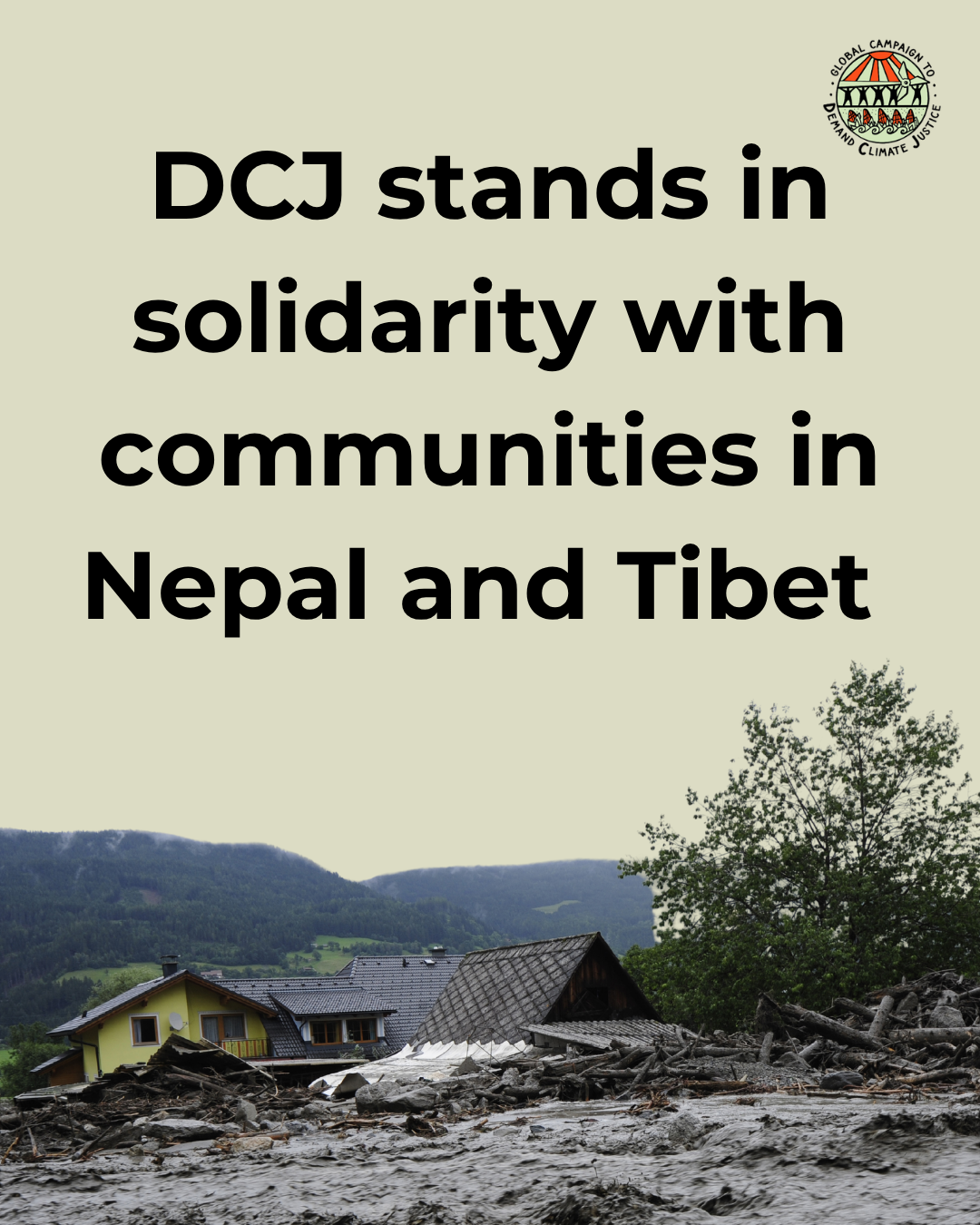
If now is not an appropriate time, then when? If the loss of lives, homes, livelihoods, cultures, and entire communities in Nepal does not constitute an appropriate moment, then when would? We cannot identify any decision in the Fund’s history that has been pursued in this manner, particularly in response to a disaster of this magnitude. More than 1,000 lives lost, 5,000 still missing, 7,500 homes destroyed, and entire communities severed from their livelihoods, territories and cultures.
There is a deeper irony here that should not be lost on the Board. In July 2025, the Green Climate Fund approved a USD 36.1 million grant for Nepal under the project ‘Protecting livelihoods and assets at risk from Glacial Lake Outburst Floods (GLOFs) and climate change-induced flooding in glacial river basins of Nepal’ – 7 years after this funding request was first submitted in 2018! Adaptation finance arrived years after the warning signs. Nepal now critically requires Loss and Damage finance to respond to irreversible harms already suffered.
The development and operationalisation of a rapid response modality is therefore a defining test of the Fund’s purpose. It would demonstrate the FRLD’s ability to fulfil its unique mandate to respond to Loss and Damage needs of communities facing the irreversible impacts of climate change. Equally, it is a test of international solidarity and cooperation, guided by the principles of equity and common but differentiated responsibilities and respective capabilities. Developed countries, which bear the greatest historical responsibility for the climate crisis and possess the greatest capabilities, have an obligation to ensure that support reaches affected communities when it is needed most.
In line with the above, we express our full support for the request submitted by the Government of Nepal to the FRLD for a special decision on a rapid response to the disaster. We likewise strongly support calls by Board Members from Least Developed Countries, African States, and Asia-Pacific States for an Extraordinary Meeting to allocate and immediately disburse rapid response funding for Nepal.
If the FRLD is to inspire confidence in its governance and establish itself as a credible institution capable of shaping the future of the Loss and Damage landscape, then proper Board consideration of this matter must be the norm, not the exception.
This is far more than a procedural matter. The scale of Nepal’s catastrophe demands an extraordinary response. The legitimacy of the Fund demands nothing less.
Sincerely,
Members of the Global Campaign to Demand Climate Justice